




-24x24h.jpg)


-24x24h.png)


Disc Brakes vs V-Brakes: Which Should You Choose?
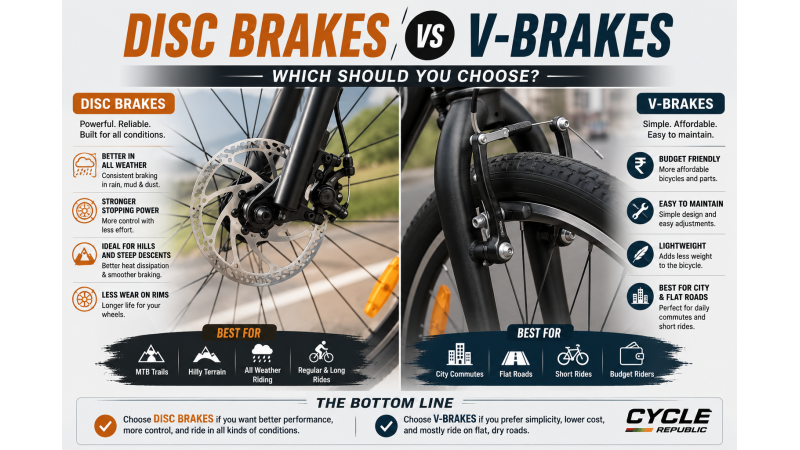
Disc Brakes vs V-Brakes: Which Should You Choose?
When shopping for a new bicycle, you'll often come across two braking systems: Disc Brakes and V-Brakes. While both are designed to safely slow and stop your bicycle, they perform differently depending on where and how you ride.
So, which one should you choose?
Let's break it down.
What Are V-Brakes?
V-Brakes (also called rim brakes) use brake pads that press directly against the wheel rim to slow the bicycle.
They've been used on bicycles for decades and remain a popular choice on entry-level and recreational bikes.
Advantages of V-Brakes
-
Affordable and widely available.
-
Lightweight design.
-
Easy to maintain.
-
Replacement brake pads are inexpensive.
-
Simple to adjust with basic tools.
For riders who mainly cycle on dry roads and don't ride long distances, V-brakes are still a dependable option.
What Are Disc Brakes?
Disc Brakes use a metal rotor attached to the wheel hub. Brake pads grip the rotor instead of the wheel rim, providing more consistent stopping power.
You'll find disc brakes on many modern mountain bikes, hybrid bikes, gravel bikes, and premium commuter bicycles.
Advantages of Disc Brakes
-
Better stopping power.
-
More consistent braking in wet weather.
-
Improved control on steep descents.
-
Better performance on muddy or dusty roads.
-
Less wear on the wheel rims.
For riders who cycle frequently or ride in varying conditions, disc brakes offer greater confidence and control.
How Do They Perform in Indian Conditions?
Indian roads can be unpredictable.
From sudden rain showers and dusty roads to traffic and uneven surfaces, your brakes need to perform reliably.
Disc Brakes generally perform better because the braking surface is positioned away from the ground, making it less affected by water, mud, and dirt.
If you've ever ridden during the monsoon, you'll notice that disc brakes maintain more consistent stopping power compared to V-brakes.
Maintenance
Many people assume disc brakes require constant maintenance, but that's not necessarily true.
V-Brakes
-
Easier for beginners to adjust.
-
Lower servicing costs.
-
Simpler design.
Disc Brakes
-
Require occasional rotor and pad inspection.
-
Hydraulic systems may need professional servicing over time.
-
Mechanical disc brakes are relatively straightforward to maintain.
Routine servicing keeps both systems working effectively.
Which Brakes Are Better for Beginners?
If you're buying your first bicycle, don't choose a brake system based on trends alone.
A V-Brake bicycle is perfectly suitable for:
-
Leisure rides.
-
Short commutes.
-
Flat city roads.
-
Budget-conscious buyers.
A Disc Brake bicycle is worth considering if you:
-
Ride regularly.
-
Cycle in all weather conditions.
-
Travel through hilly areas or flyovers.
-
Want stronger braking performance with less effort.
Should You Spend More on Disc Brakes?
If your budget allows, yes.
Disc brakes aren't just about stopping faster—they provide greater control, especially during emergency braking and on slippery roads.
For many riders, that extra confidence makes cycling more enjoyable and safer.
However, if your rides are short and mostly on dry roads, a well-adjusted V-brake bicycle will still perform very well.
Our Recommendation
For most cyclists today, especially those riding in cities like Bengaluru, Hyderabad, Pune, or Chennai, we recommend Disc Brakes.
Frequent traffic, flyovers, unexpected rain, and mixed road conditions make the additional braking performance worthwhile.
That said, a quality V-brake bicycle remains an excellent option for beginners, students, and recreational riders who want a reliable and affordable bicycle.
Final Thoughts
The best brake system depends on your riding style, budget, and local roads.
If you're looking for maximum performance, confidence, and all-weather reliability, choose Disc Brakes.
If you want a simple, dependable, and budget-friendly bicycle, V-Brakes are still a great choice.
Not sure which bicycle is right for you? Visit Cycle Republic, and we'll help you compare models and choose the one that best suits your riding needs.